

“We are in a tremendous amount of trouble. There are fundamental problems not only with the candidates, but also our tactics and the message…”
“We really need to work on the question of what we are for. Unless we have a vision and the arguments to match, I don’t think we’re going to truly connect with the American people…”
“We have to become a party of inclusion, not outreach. We have to recognize that if you’re not going to be competitive with Latinos, with African-Americans, with Native Americans, with Asian-Americans, you’re not going to be a successful party…”
“We have got to stop dividing the American voters. If we’re going to continue to be a competitive party and win elections on the national stage…we need two messages to get out loudly and clearly. One, we are fighting for 100 per cent of the votes. And second, our policies benefit every American who wants to pursue the American dream, period.”
Recognize these quotes? In the aftermath of Kamala Harris’s loss to Donald Trump, and the subsequent, albeit delayed, autopsy report from the DNC have painted a bleak picture about how Democrats feel about their party and their prospects for the future.
Only those quotes aren’t about 2024. The first is from the chairman of the Iowa Democratic Party and the second is from former Vice President Walter Mondale, both immediately after John Kerry lost the 2004 presidential race to George W. Bush.
But surely the next two quotes are pulled from the DNC’s report.
Nope. And they’re not even from Democrats.
The first is former House Speaker Newt Gingrich and the second is former Louisiana Governor Bobby Jindal lamenting Mitt Romney’s 2012 loss to Barack Obama.
When a political party loses at any level, but especially the national, there is always a lot of soul searching in the aftermath. And by soul searching I mean finger pointing. I get it. I’ve worked on both winning and losing campaigns, and if you’ve never poured your blood, sweat, and tears into a political campaign, take it from me, the sting of a loss cuts deeper than how high the thrill of a win can take you.
But let’s back up a moment.
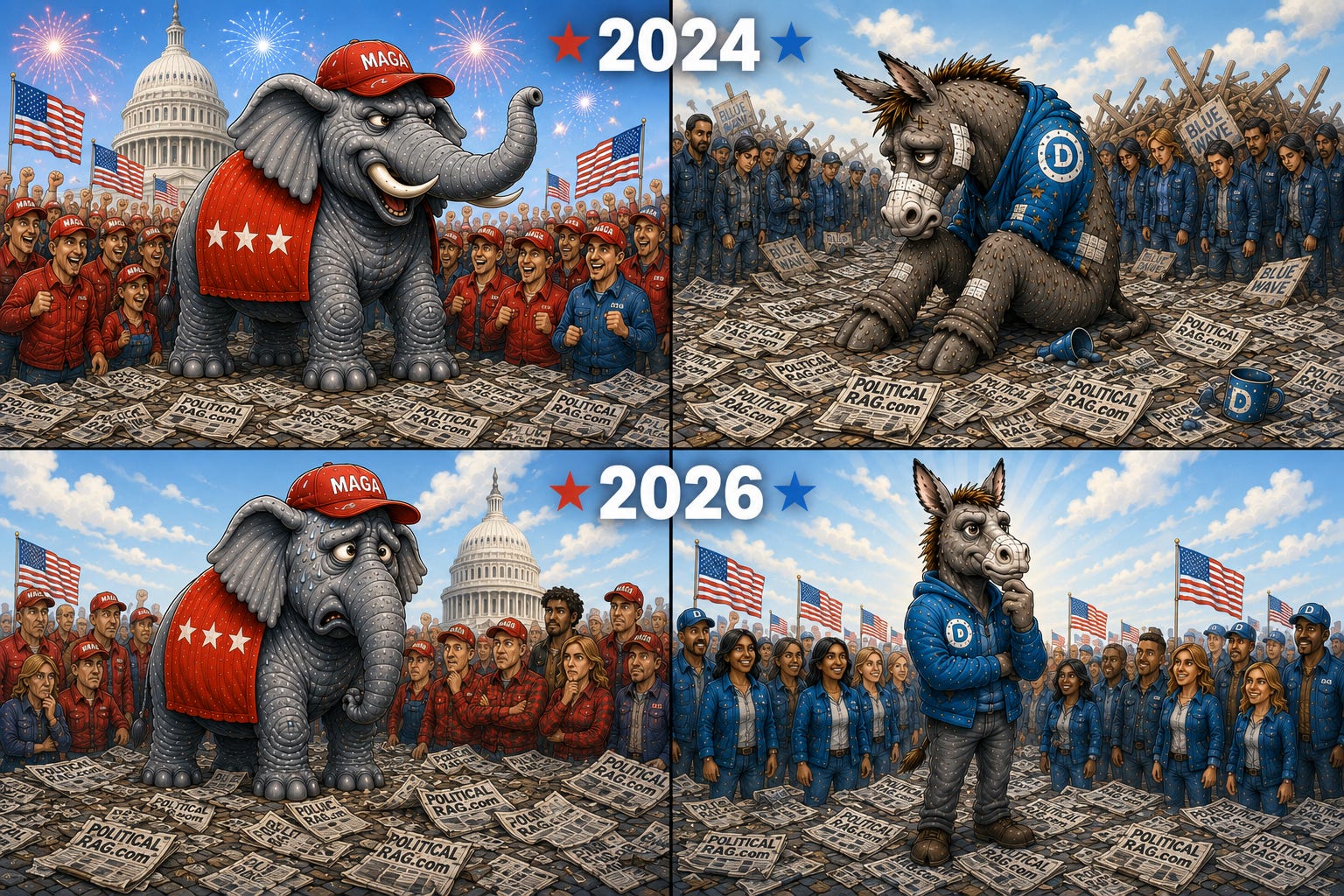
If the sentiments from 2004 or 2012 proved to be true, then both the Democratic and Republican parties would have never won the White House ever again. But of course, that’s not what happened. Four years after John Kerry’s loss, Barack Obama won by nearly 10 million votes and flipped nine states from red to blue. Cue the handwringing by Republicans for failing to unseat him in 2012. But then four years after that, Donald Trump stunned the world and flipped six states from blue to red, including the previously indestructible “blue wall” of Michigan, Pennsylvania, and Wisconsin. Cue the handwringing by Democrats. Four years later – blue wall rebuilt. Cue the handwringing by Republicans. Four years later – blue wall destroyed.
You see where I’m going with this.
So, while Democrats are still busy pointing fingers, let’s see what’s going on for the party in the upcoming midterms.
Trust to handle economic issues have been a strength for Trump and Republicans for several years. In 2024, 75% of Americans had said then that inflation was causing them some sort of hardship. Trump won voters who rated the economy in 2024 as bad, 69%-29%. Flash forward to a Fox News poll from April of 2026 and the Democratic Party is now winning on these issues. Voters now trust Democrats by a 4-point margin on handling the economy, 52%-48%. By an 8-point margin, Democrats are trusted to handle inflation and prices, 54%-46%. Trump has a 32% approval ratingand a 64% disapproval rating on handling the economy, and a disastrous 25% approval rating and 72% disapproval rating on handling inflation.
Looking at independents, April polling from Cook Political Report examining the 36 most competitive House districts finds independents giving the president a 70% disapproval rating and favoring Democrats by a whopping 25-point margin. In the 2018 midterms, exit polling found Democrats winning independents by 12 points. The same polling from Cook shows that by a wide 36-point margin, independents feel like the president and Republican have failed to deliver on their promises from 2024.
Let’s drill down a little more into the base of the GOP. A February poll from Fox News found that Republicans lead among non-college whites has falling to 10 points, versus the 34-point margin that Trump won them by in 2024. Like the numbers above, it’s driven by pocketbook issues, with non-college whites from a May Fox News poll giving Trump just a 33% approval rating on the economy and an even lower 25% on handling inflation.
This is a massive collapse, that if holds true on Election Day, would point to a similar situation in 2006 when Republicans won this group by a 6-point margin but were wiped out in the House. Because it’s not enough to just win this group, which has predominately been part of the GOP coalition over the last several years, but they must turn out in large numbers for Republicans too. However, looking back at the last five midterms since 2006, non-college voters turned out by an average 37%, versus Democrat-leaning college voters who have turned out by an average 64%.
Something to point out as well, that level of trust that has swung to Democrats on voters most important issues is based on the generic ballot. Not even an actual candidate with a name who is carrying the banner and leading his or her party. But that can be a double-edged sword for Democrats as they’re benefitting from being the only other viable choice. It doesn’t mean they are popular.
Polling from Gallup finds that the image of the Democratic Party as a national brand sits at a 34% approval rating versus 38% for Republicans. Some of this is driven by Democrats view of their own party, who give it a 73% approval rating compared to 91% for the GOP among Republicans. This is typical of parties in power versus parties out of power. Approval among Republicans of the GOP dropped to 78% in 2021 and 63% in 2009.
But do the Democrats need to be popular to win back Congress? Not necessarily. Midterm elections are always a referendum on the sitting president (see my article on this here: The Midterm Lens), and the pendulum only swings two ways in the U.S. And winning elections can do wonders for a party’s standing, especially among its base. So, when Democrats have a good night in November, expect to see party leaders whistling a different tune and looking ahead with confidence to 2028. If Democrats have a really good night and win some unexpected races or take both the House (pretty much a foregone conclusion) and the Senate (a tall order but the prospects have improved), then expect to see the handwringing among Republicans begin and they’ll start to look beyond the Trump Era in earnest.
So, while autopsies post-loss are fine for understanding why it was a party lost, the pronouncements from those internal players about how much the party is in trouble are overblown. Longstanding majorities are a thing of the 20th century, not the 21st. The pendulum swings often and hits hard, but the moment it starts swinging away from one party it’s picking up momentum against the other party (see my article on this here: The Pendulum). We can debate whether this is healthy or chaotic, but it is the political environment we have had for most of the past 26 years.