


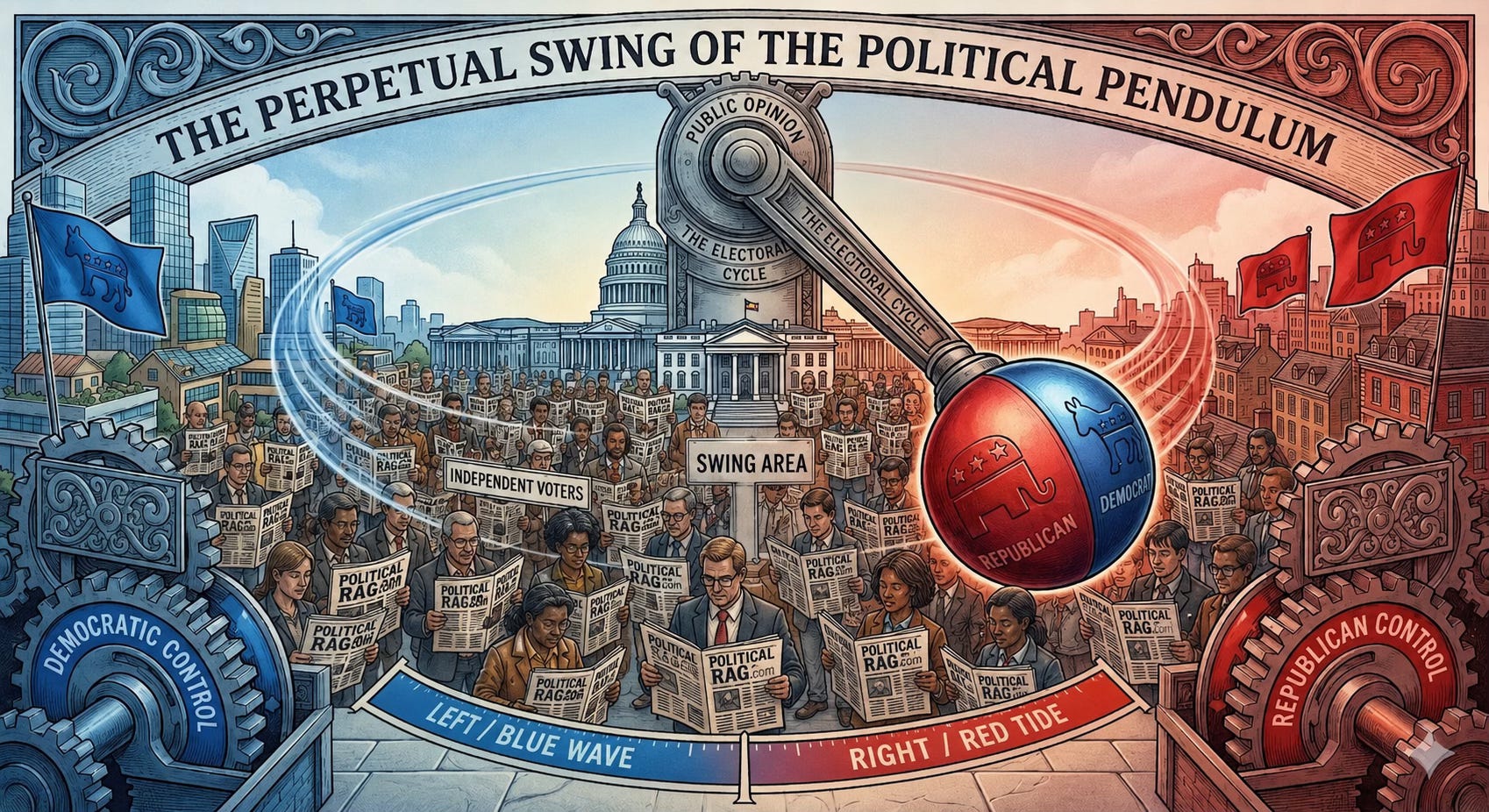
If you’ve ever found yourself wondering why it seems like nothing gets done in Washington, the answer is simple – the pendulum of power only swings two ways, and in the 21st century, it swings often.
We have now had six elections in a row (2014, 2016, 2018, 2020, 2022, and 2024) where party control has changed in at least one of either the House of Representatives, Senate, or the White House. This sets the record of constant churn in our two-party era (which I count since 1874, post-Civil War and all Confederate states readmitted to the Union). But we have also set the record going all the way back to the first election under our constitution in 1788 when there was more rise and fall to major and minor parties, versus the firm two-party hold we know now. Both pre-1874 and since 1874 the record was five consecutive elections of change.
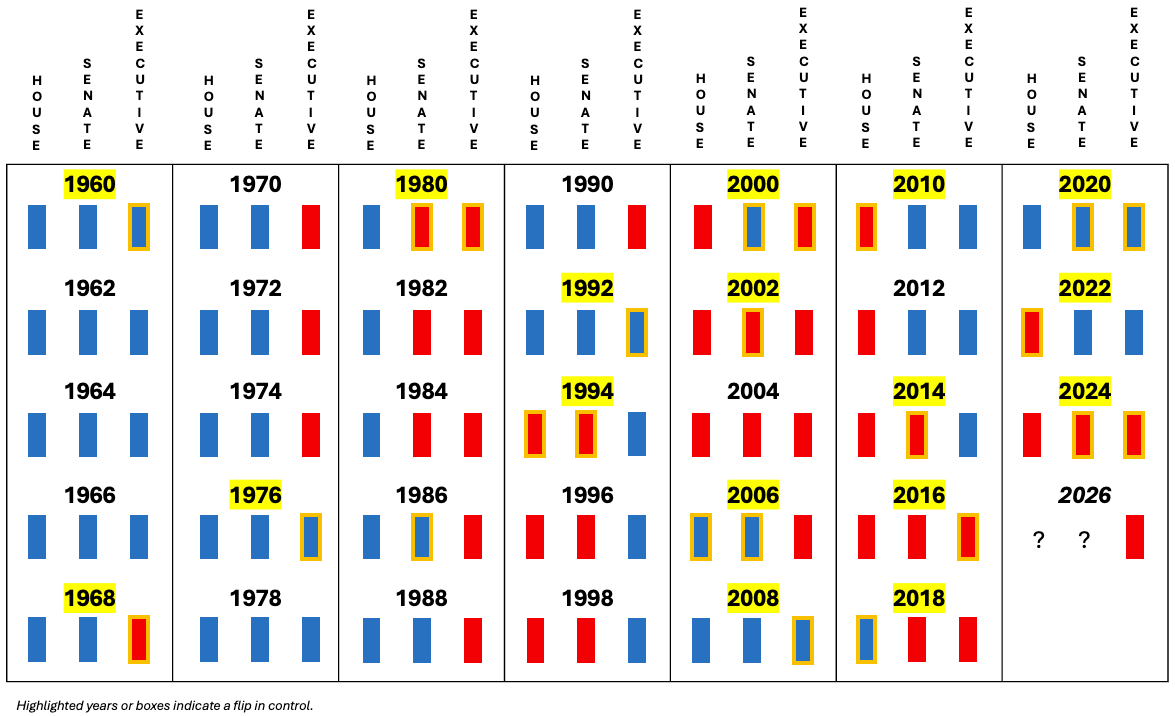
All indications point to a lengthening of the record in 2026 to seven consecutive elections.
So…what gives?
The first thing to understand is that a midterm election, like 2026, almost always go against the party that holds the White House. It is voters’ opportunity to cast judgement on the party in power. The opposition party is usually more enthused to vote. The party in power is generally worn down.
The second thing to recognize is that we are a narrowly divided country. No president has won the national popular vote by double digits since Ronald Reagan’s 18-point landslide in 1984. Since then, the closest anyone has come is George H.W. Bush and Barack Obama’s 7-point wins in 1988 and 2008, respectively. But in ten presidential elections since 1984 the average difference between the popular vote winner and loser was 4.4 points. In half of those elections, neither candidate achieved a popular vote majority (50%+1). In two of those elections, the popular vote winner was not elected president.
In Congress, the numbers are even more narrowly divided. Since the 1874 election, both parties enjoyed periods where they held large, sustained majorities in both the House and Senate, holding 60% or more of seats. But the 21st century has seen small majorities that continually flipflop. Since the 107th Congress (2001-2003), both parties have held an average 49 out of the 100 seats in the Senate, neither party growing their majority beyond the 58 held by Democrats beginning in the 111th Congress (2009-2011). The same period in the House has seen Republicans hold an average 50.9% of the 435 seats, while Democrats have held an average 48.9%. Neither party has exceeded the Democrats 59% of seats in the House, held during the 111th Congress.
The final part to understand is the pure politics of it all.
When the pendulum swings back and forth this quickly, and it only takes a stiff breeze to knock over a majority in Congress, there is no incentive for either party to want to do too much to help each other out. It’s easier to demonize and make a reasonable bet you’ll be back in charge if you’re the currently minority party. Then the majority becomes the minority and the cycle begins anew.
