

A Reuters/Ipsos poll out in late June asked Americans the question if they thought it has been worth the United States taking military action in Iran. Just 24% of the registered voters polled said yes. 55% said no, including 55% of independents and even one-quarter of Republicans.
The conflict with Iran never started from a position of widespread support from the American public. The average of polling from Silver Bulletin found that on March 1, just a couple days after the conflict began, 35% of Americans were supportive while 47% were opposed. Four months later, 35% of Americans are still supportive while opposition has grown to 57%.
With the Midterms looming it naturally begs the question of how the war will make its mark on the election? History offers some useful clues.
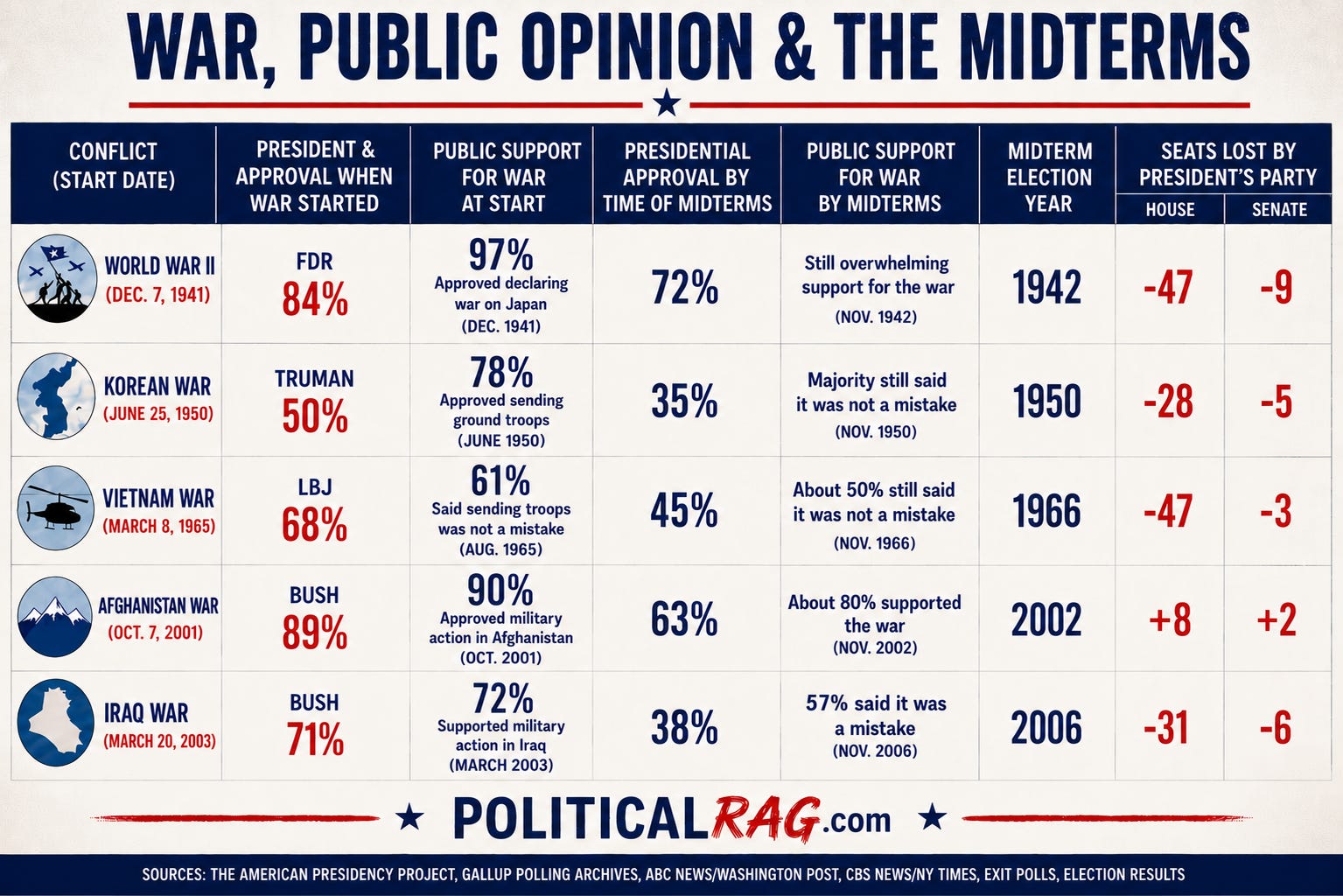
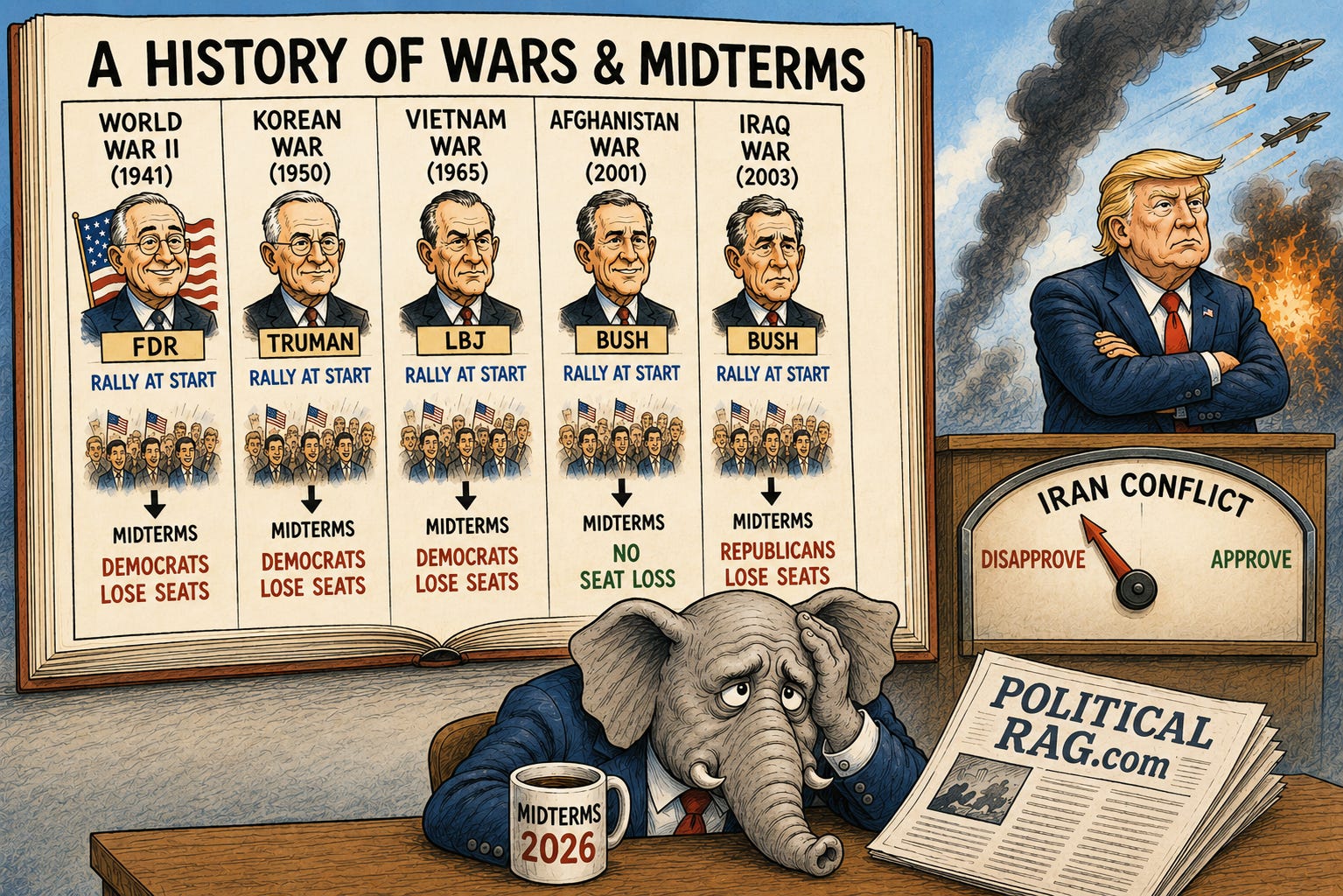
Midterm elections and wars have intersected in a major way five times since the advent of public polling. Looking at World War II, the Korean War, Vietnam, Afghanistan, and Iraq we find strong “rally-round-the-flag” effects for the president in the opening phase of each of these conflicts, usually followed by public backlash when voters reach the polls.
In the first four instances, public opinion had not turned against the war by the time of the respective midterms. America had only been involved in World War II for just under a year by the time of 1942 midterms and public support for the war was still near universal, and President Roosevelt enjoyed a high level of support. Instead, most historians agree what Americans were frustrated with was mismanagement on the homefront with costs and rationing. Some historians believe too that FDR’s personal popularity was shielding frustrations with his party and Congressional Democrats took the heat the midterms.
A similar situation occurred with President Truman by the time of the Korean War. Most Americans still supported the aims of the war, especially in terms of seeing it as part of the communist containment strategy. However, Truman began to lose the support of the public for his management of the war abroad and management of the country at home with rising inflation and shortages. The country was also on year seventeen of full Democratic control and was beginning to look toward Republicans for new leadership.
By Vietnam, President Johnson was riding a high wave of support when he committed troops to southeast Asia just four months after his landslide re-election in 1964. A large majority of the country still believed in containing communism, and Vietnam was the next battlefield. By the time of the midterms in 1966, most of the country still supported the war, but Johnson’s personal popularity began to fall, again mainly due to views of his mismanagement of the war and the homefront. His party took the brunt at the ballot box.
Enter the twenty-first century, and most of us know the story. George W. Bush was perceived as a strong leader post-9/11 and was seen as successfully executing the war in Afghanistan (the “good war” as it would later be termed in comparison to Iraq). A year later, the 2002 midterms proved the lone exception as it was widely supported, and Bush continued to be seen as a solid leader both at home and abroad. When the administration made its case for attacking Iraq in 2003, it was seen as part of the broader War on Terror. Though Bush’s popularity had declined by 2004 from massive highs, he still won re-election. But by the time of the 2006 midterms, public opinion had turned massively sour not just from perceiving the war as a mistake, but also for mismanagement on the homefront (e.g., spending, Hurricane Katrina, etc.). Once again, the party in power took a “thumpin’” as Bush called it.
Fast forward to today.
The conflict with Iran never enjoyed widespread support. Trump has Truman/Bush levels of popularity currently. At the moment, Iran does not register as a top level of concern for the American public, especially as they’re thinking about their vote for the fall. But where it does come into play is how Americans are evaluating the administration as a whole. They never supported the conflict from the start and fewer do today. The war has added to higher energy costs and disruption in global commerce. Americans have said repeatedly this year that costs and inflation are their primary concerns. They give Trump low marks for his management on the homefront.
Taken together, history suggests Republicans face the kind of environment that has historically been difficult for incumbent parties. The lesson isn’t that wars automatically doom presidents. It’s that wars become another test of presidential leadership. As I’ve written before, midterms are all judged by voters through the lens of the sitting president (See here: The Midterm Lens). By the time voters reach the ballot box they tend to judge the administration’s overall management — not merely whether they support the conflict itself that plays into their thought process.