


The simple math says that for Democrats to reclaim the Senate majority in 2026, they need to net a four-seat pickup this fall. It’s looking increasingly likely that they at least nab one seat with Roy Cooper in North Carolina. Beyond that, it’s looking like a harder climb up hill given that any path to the majority goes through states that Trump won in 2024.
But if we peel back a layer of the onion, we find a much more competitive landscape that works in Democrats favor.
There has not been a ton of reliable polling done yet and there are certainly dynamics in each individual race that can swing things toward one party. But we can look at the overall trends in the election by examining the generic congressional ballot.
As I have previously written about (see here: Can Redistricting Save Republicans?) every state in the country has moved left by some degree, relative to its 2024 presidential outcome. That makes things interesting for House races and especially interesting for the Senate. The 12 races in the table below explain why.
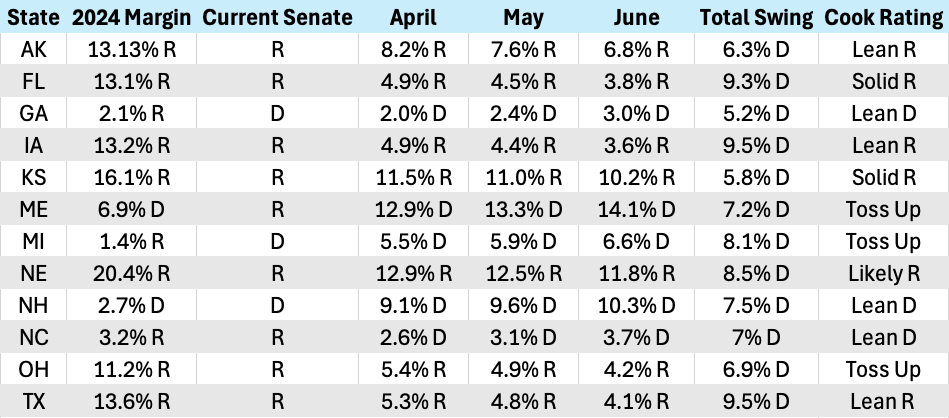
Source: 2024 Presidential Results, Silver Bulletin, Cook Political Report
Each of these races, except for Florida and Kansas, is currently expected to have some level of competitiveness. The numbers tell the tale. Relative to their 2024 presidential margin, each state has continued to drift leftward. Over the last three months, the generic ballot in each state has become bluer, and as of June, each state has swung an average 7.5% to the left.
In the most competitive or purple states like Georgia, Maine, or North Carolina, this isn’t that surprising. But look closer at a state like Florida. Incumbent Republican Senator Ashley Moody is currently expected to have a solid run to re-election, but Florida has made nearly a double-digit swing to the left, now sitting just below a 4% Republican advantage on the generic ballot. Recent polling from Cook Political Report found that any Congressional district that President Trump carried by 10% or less in 2024 could go Democratic in 2026. Trump carried Florida by 13-points but has drifted nearly 10-points left. If that trend continues, a combination of a strong challenger from Democrats with enough money and the right message puts Florida in play.
The same goes for each of the states in the table above currently held by a Republican. That’s why states like Ohio are a Toss Up or Alaska is a Lean Republican. Democrats recruited strong, well-known challengers who have been prolific fundraisers.
One high quality poll of Ohio that came out recently from Fox News highlights why states that have been reliably Republican are suddenly competitive. The poll found former Democratic Senator Sherrod Brown with a 53-45% lead over Republican Jon Husted, who was appointed to fill the seat vacated by Vice President Vance. The fact Brown is above 50% with only 2% undecided is a telling sign.
But what’s driving Brown’s numbers is the same story we’ve seen around the country – concerns about economic issues. A combined 51% of Ohioans rated inflation and jobs as their top issue when deciding how to vote. 39% of voters said they are falling behind in their personal financial situation while 49% said they’re holding steady. Browns support is not driven just by the typical Democratic voters either. He’s winning independents by a wide 18-point margin, men with 51%, and even pulling in 45% of non-college white voters and 43% of rural voters, two key groups for Trump in all three of his elections.
Brown’s supporters are almost much more likely to turn out. 60% of Democrats are extremely motivated to vote, versus 53% of Republicans. An even higher 66% of 2024 Harris voters are extremely motivated to vote, versus 52% of 2024 Trump voters. Like most incumbent presidents, Trump suffers from his coalition failing to turn out when he’s not on the ballot. This could be driven by President Trump’s 57% disapproval rating the Buckeye State, which includes 48% of non-college whites and 49% of rural residents.
Now, let’s level set here.
This is a much more competitive map and creates more paths to a majority for Democrats, but still one with an uphill climb. Their most likely opportunity to net four seats comes through Alaska, Maine, North Carolina, and Ohio. But it’s only North Carolina that is starting to look the most promising as former Democratic Governor Roy Cooper is fairly popular while former RNC Chairman Michael Watley is largely unknown. Alaska has a history of electing Democrats and Mary Peltola has proven before she can win statewide, but the state is still pretty Republican. In Maine, Democratic nominee Graham Platner is plagued by scandal, and incumbent Republican Susan Collins has faced tough races before and always prevailed. Ohio is starting to look better for Democrats but is still not as fertile a field as a purple state like North Carolina.
The next best opportunities for Democrats are Iowa and Texas. I’ve previously written about why Texas is now in play (see here: Yes, Ken Paxton could lose Texas), but still a tough slog for Democrats. Iowa will feature several competitive races for governor, three U.S. House seats, as well as the Senate. But Iowa has been a reliably Republican state at nearly every level on the ballot for more than a decade.
States like Florida and Kansas would be a real reach for Democrats. While Florida has swung heavily left in polling since 2024, it is still a state that has eluded Democrats at nearly every statewide office since Barack Obama was the last presidential candidate to win it in 2012. In Kansas, Governor Laura Kelly has proven a Democrat can win statewide against a controversial Republican opponent. Incumbent Senator Roger Marshall has angered a lot of his constituents, but his potential biggest threats to re-election, Representative Sharice Davids, and Governor Kelly herself, both passed on a run against him.
Nebraska is interesting with Dan Osborn running as an independent. Osborn came within 6 points of defeating Republican Senator Deb Fischer in 2024, an impressive feat considering Trump carried the state by 20-points. Osborn has been a strong fundraiser and if Democratic nominee Cindy Burbank drops out, as some expect her to, Osborn could have a more favorable environment than he did two years ago to make the case for an independent senator, though many suspect he would caucus with the Democrats.
This assumes Democrats don’t lose any seats and right now they’re slogging through a bitter primary to hold onto a seat in Michigan. So, everything must go right for Democrats. But also, everything seems to be going wrong right now for Republicans. Gas prices remain high while the war in Iran grinds on. President Trump, fixated on vanity projects while saying he “loves the inflation,” continues to sink to new lows in popularity.
But contrary to a lot of punditry, this is competitive map. Nothing is guaranteed for either party. Republicans maintain the edge, but Democrats have a clear path toward a majority, albeit one that goes uphill.