



To hear Republicans tell it the mid-decade redistricting wins they’ve seen, through both state legislature and court interventions, are going to save their House majority this year.
But will it?
Perhaps a few seats will be saved by Republicans that otherwise would have gone Democratic. But that doesn’t tell the full picture of the uphill climb Republicans face this year. That itself is not that much of an earth-shattering prognostication – it’s a midterm election and Republicans are the incumbent party. Peel back a layer of the onion about voter sentiment and you’ll find a picture more bleak for the GOP than a few additional seats in their column can do to save their House majority.
Voter sentiment shows that every single state has shifted left compared to its 2024 presidential vote.
You read that right. Every single state has shifted left.
When looking at the data of the generic congressional ballot question from polling, you’ll find that every state has shifted left by an average 6.6%. When looking at the median percentage, it shrinks slightly to a 6.2% leftward swing.
Now, I can already hear the naysayers saying “Yea, but Rhode Island…” (the most Democratic swing) or Wyoming (the least Democratic swing) and okay, I see your bet and I’ll raise you. If we remove both the least competitive Democratic and Republican states and just focus on the sixteen states with a competitive House race that swing increases in Democrats favor to an average 7.5% and median 7.4% shift left.
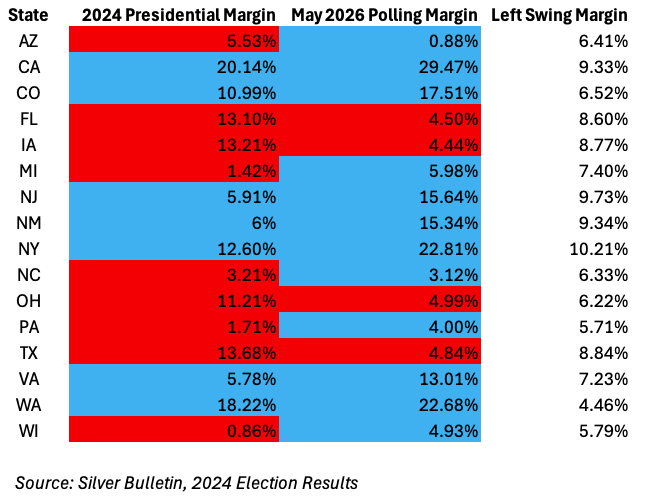
These sixteen states represent a good cross section of red, blue, and swing states at the presidential level and shows the growing backlash against the Republican majority. Even if we remove the five states that have gone through a redistricting (California, Florida, North Carolina, Ohio, and Texas) the average leftward swing is still a 7.4% margin.
Now, let’s drill down to the individual races. Remember, Democrats need just a net pickup of three seats to take the majority in the House. If we look at Cook Political Report’s toss-up races in states that didn’t redistrict, there are thirteen Republican-held seats that would shift to Democrats based on the incumbents 2024-win margin versus the Democratic polling shift in that state in 2026.
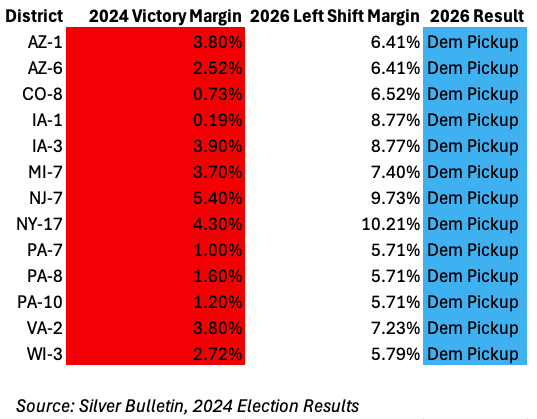
If we add five more seats to the Democratic column due to redistricting and a very favorable flip in the Omaha-centered Nebraska 3rd district, that put Democratic flips at 18. Now, let’s add 11 seats to the Republican column due to redistricting and a very favorable opportunity in the rural Maine 2nd district. That still leaves us with a Democratic majority in the House, with four races still unaccounted for. Those four races are FL-25, OH-9, TX-34, and WA-3, all of which have a Democratic incumbent running for re-election who won in 2024 while Donald Trump also won their district. Trump is not on the ballot now and the national environment favors Democrats this time, so we can reasonably keep those four seats in the Democratic column.
That gives us a 7-seat Democratic majority in the House. If we assume that Republicans in southern states successfully redistrict in the wake of the U.S. Supreme Court ruling on the Voting Rights Act, that net’s Republicans one seat a piece in Alabama, Louisiana, South Carolina, and Tennessee. This reduces the Democratic House majority to four seats.
It is the narrowest of margins and still does not account for other Republican seats that lean in their favor but are still competitive given the unfavorable environment. Polling from Cook Political Report also found that any district President Trump carried by ten points or less in 2024 could be in danger of flipping to Democratic control. This also doesn’t consider the Senate which is becoming more competitive to the GOP’s detriment.
At best, for all the Republicans efforts, they will likely just mitigate losses, rather than retain the House majority – and a Democratic majority all but slams the brakes on President Trump’s agenda for his final two years in office.