

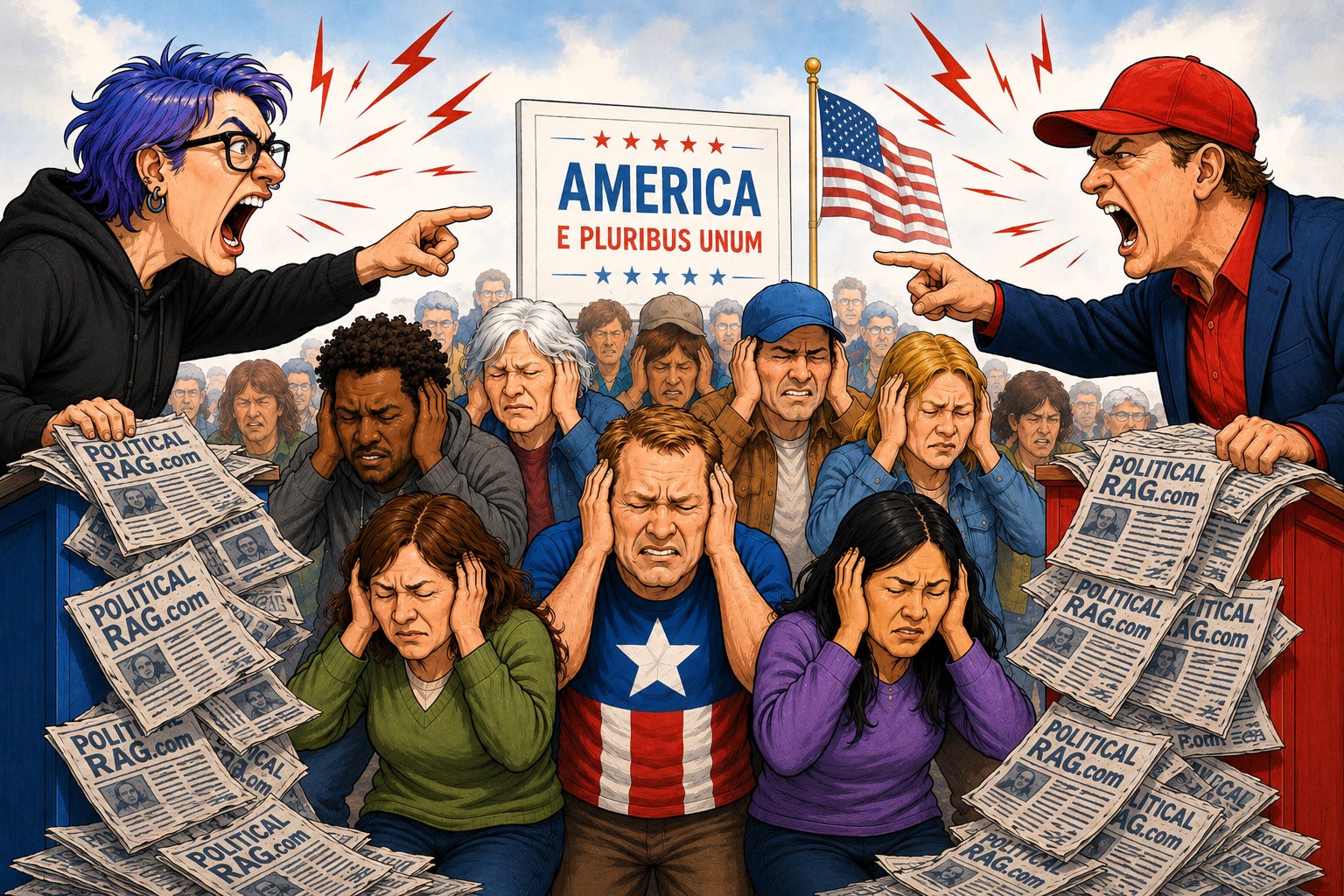
In case you missed it, and judging by the results it showed, some people may have, Pew Research Center released data this week breaking down the typical red versus blue partisan divide that we assign to elections, and pretty much everything else nowadays. Raise your hand if you’ve ever been told you’re not patriotic enough because you listen to more punk rock than you do country (slowly raises hand).
But the bottom line from the survey was this – Americans hold a complex mix of opinions and values that can’t be fit neatly into one of two boxes (aka: our two-party system). We vote the way we vote because those are essentially our choices, and as Drew Westen’s research in The Political Brain shows us, we internally rationalize our choice even if we don’t like it. And only a minority of us are committed to the core to the tenets of a single party. The graphic below from Pew breaks it down.
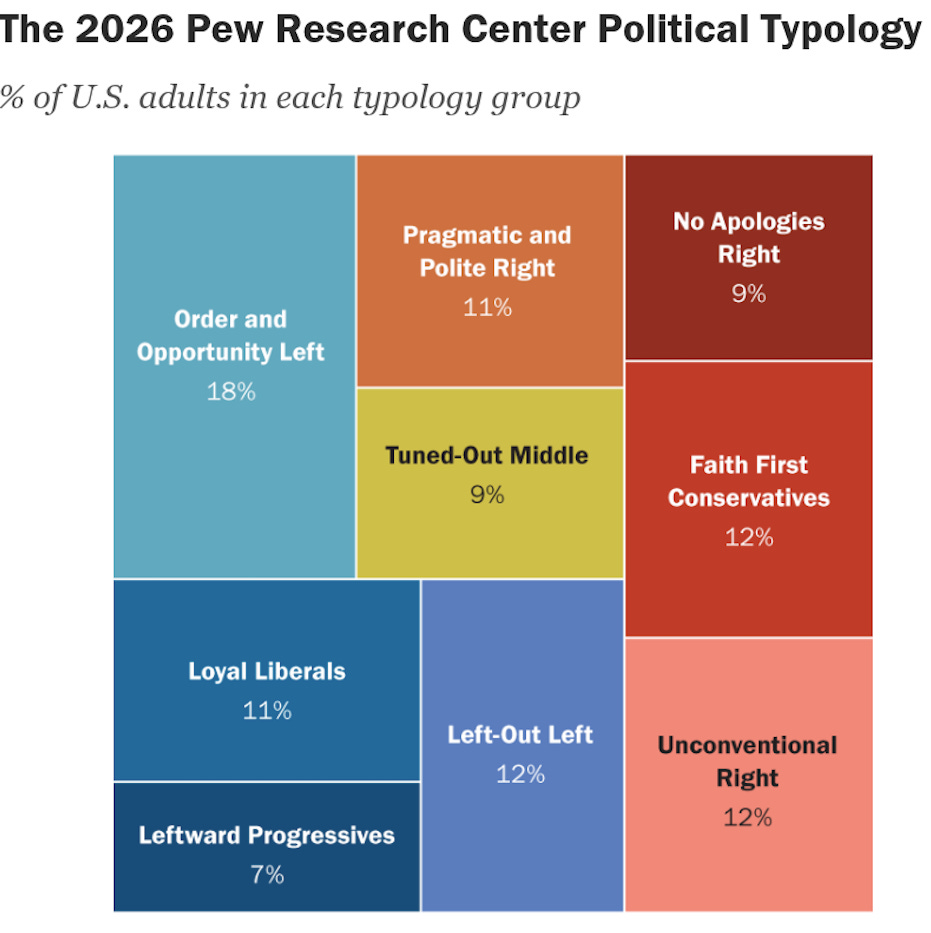
I won’t define all of these, but I encourage you to read the article from Pew to see what each means. But for the GOP, there is the No Apologies Right and the Faith First Conservatives, who are the most committed to the party and to Donald Trump. They make up 21% of voters. On the left, there are the Loyal Liberals and Leftward Progressives, who are the most committed to the Democratic Party, if somewhat skeptically in the case of the Leftward Progressives. These two groups make up 18% of voters.
Doing the math here (always a risk for me in public), that’s 39% of voters from both parties who are the most loyal, most tuned into politics, and the highest propensity voters. For the conservative side, the two groups turned out to vote in 2024 by an average 77%. For the liberal side, the two groups turned out by an average 72%. But what about the other 61% of the country? Those five groups turned out to vote by just an average 51%.
And why should they turn out? Just an average 17% of those five groups think there is always or often at least one candidate who shares their views. They have a collective 60% unfavorable view of the GOP and a 55% unfavorable view of the Democratic Party.
What drives those sentiments? Well, look at how they feel about issues. Collectively, 38% feel that the U.S. economic system is only somewhat fair. 66% believe illegal immigration is a problem. 55% believe we need stricter gun control laws. 55% aren’t overly concerned about the status of the wealthy.
I just threw out four red meat issues consistently served up on either side, respectively, to the 39%, that are used to stir up both sides. Of course, we know why. They’re the loudest voices in politics, drowning out what the larger majorities of Americans think and feel about the issues that impact us.
I teach a nonpartisan campaign school. Through the years I’ve had a mix of over 600 Democratic and Republican office-seekers in 23 states who have sat in front of me and my advice is the same to each of them regardless of party – candidates who build large coalitions and win with large majorities aren’t appealing to that 39%. They’re appealing to the other 61%. That doesn’t mean the 39% don’t have opinions that matter. They absolutely do, as every American does. But if you’re only trying to placate the 39%, you’ll lose, or win by the barest margin, at best. Do the 2016, 2020, and 2024 presidential elections ring any bells? Now consider the elections of Ronald Reagan or Barack Obama. Yes, I just threw out two presidents reviled by their opposition. That’s the point (see my About page: “Spinning, I’m not here to do anyones”).
So, we’ve got an election coming up. If either party wants to command a bigger majority in Congress, they should figure out how to talk to the 61%. If either can do this and then govern in a way focused on the big ideas that have large, supportive majorities of the public, and tune out the noise that appeals to just their own share of the 39%, then that party could set themselves up for a long-standing majority.
If either is willing to do so.