

Nearly every sitting president must face the midterm curse – the maxim that the party that holds the White House will likely lose seats in the House (and usually, but not always, the Senate) once voters get to cast their judgement on the incumbent government. And every president, regardless of party, has done what he could to stop the rule from remaining true on his watch. But looking back at every midterm election since 1938 (and the advent of scientific public polling), the executive branch is averaging just a 9% success rate helping the president’s party in the legislative branch stave off defeat.
Even with a low success rate, incumbent presidents deploy the same tactics each time. They either make the elections about defending or advancing the agenda they were elected on just two years prior, attack the alternative, deliver a pledge about what the next two years could bring, and usually combine all three.
In 1938, President Roosevelt made the election a referendum on the coalition of conservative Democrats and Republicans who opposed his New Deal agenda, attacked them for only paying lip service to the reforms he was offering, and implored Americans to pick candidates for Congress who have already proven they can deliver for the country. In a fireside radio address, just days before the election, he framed the fight by saying, “New ideas cannot be administered successfully by men with old ideas, for the first essential of doing a job well is the wish to see the job done at all.”
Democrats went on to lose 72 House seats and 8 Senate seats. Not to mention 12 gubernatorial flips.
The problem for President Roosevelt and all of his successors is that regardless of the success of their own election, their personal popularity (FDR had a 60% approval near Election Day), or what they believe is the purity, altruism, or enlightenment of their ideas, voters are looking at things through a very different perspective. Usually that takes the form of opposition to policy, macro factors such as economic conditions, or even the leadership of the president himself. While history can eventually prove president’s right (93% of Americans today have a positive view of Social Security), even new government programs can initially be seen as federal overreach – exactly a key piece of the opposition to the New Deal in the 1930’s.
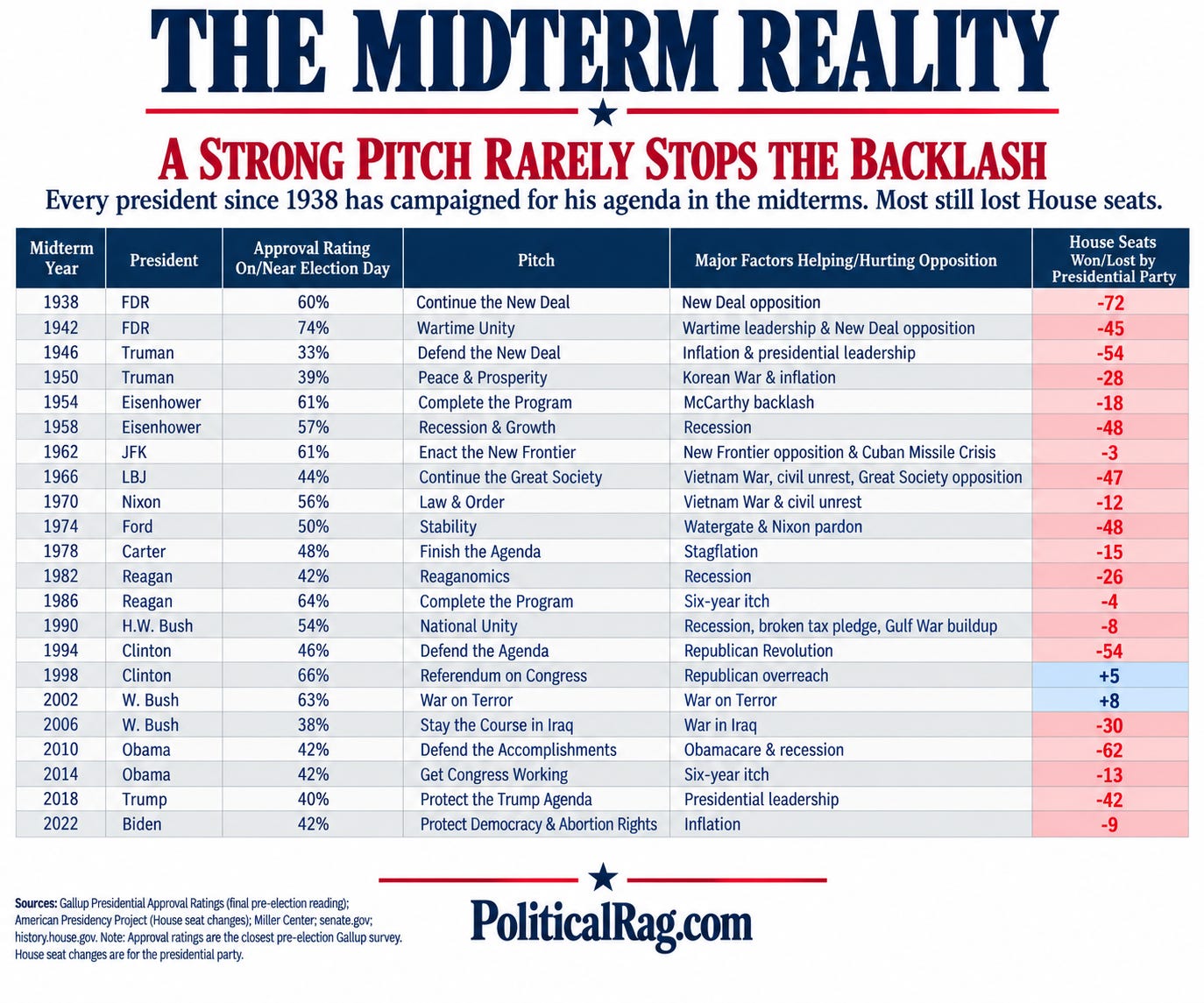
The midterm curse goes on from there, uninterrupted until 1998. Eight midterm elections saw the incumbent president sitting on a positive approval rating around Election Day (Ford was at 50% – good enough). Six saw the president sitting on a negative rating. The president makes his pitch, sometimes paints it in stark terms, and in all fourteen election his party goes on to lose seats in the House. It wasn’t until Bill Clinton in 1998 and George W. Bush in 2002 beat the curse, but even Clinton experienced it in 1994, while Bush saw a thumpin’ (his words) in 2006. And the curse has continued, unabated, since 2006.
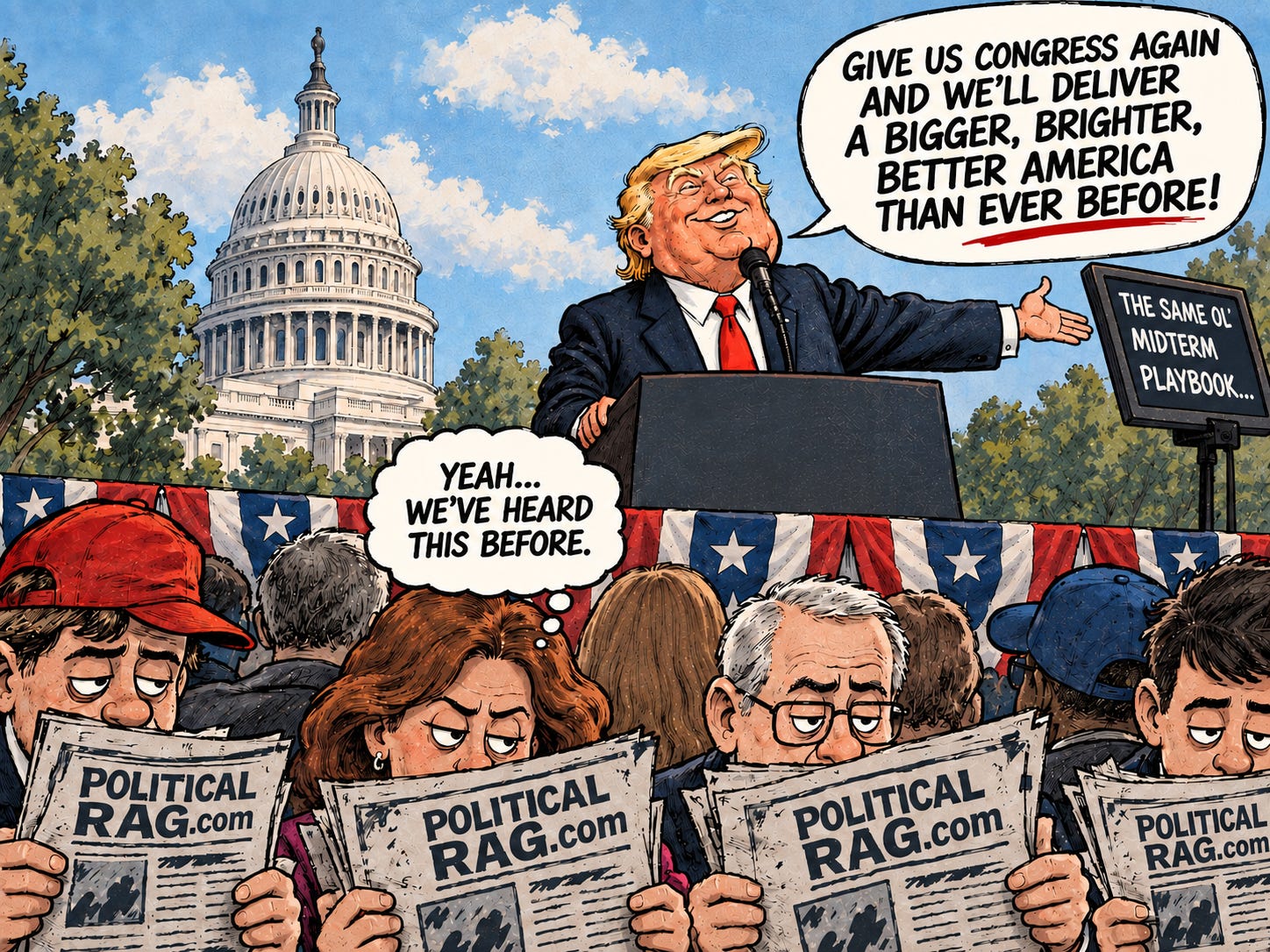
That brings us to the 2026 midterms. Last week, at an unconventional midterm convention, President Trump made his pitch, as all his predecessors have done. And like his predecessors, he has followed a familiar playbook:
· Defend/Advance the Agenda: downplay inflation, talk tough on the war with Iran, tout the One Big Beautiful Bill
· Attack the Alternative: Liken Democrats to communists
· Make a Pledge: $5,000 “Trump Dividend” for every American adult if Republicans retain control of Congress
The problem for the president is not that, apart from the $5,000 dividend pledge, his pitch is historically unusual. It’s that he is attempting the same maneuver presidents have repeatedly attempted from a relatively weak political position. His approval rating sits at 38%, while polling consistently has Democrats ahead on the generic congressional ballot.
Whether the playbook works this time around remains to be seen, but history shows us that even if Trump and Republicans were riding a high wave of support, the GOP would still be likely to lose seats in the House. As it were, history shows us that a president with a negative approval rating has never had his party gain House seats in a midterm.
The point isn’t that presidents shouldn’t campaign for their parties in midterms. The point is that presidential persuasion has historically been a weak force against the underlying dynamics of a midterm election. Even if voters like a president’s agenda, approve of his performance, or even agree that the opposition would make things worse, midterms give voters an opportunity to register their dissatisfaction with the direction of the country.
They overwhelmingly use it.
© 2026 Center Field Strategies LLC | Political Rag is an imprint of Center Field Strategies