

New data out from Gallup finds a growing divergence in American adults identifying as Democrats, or independents who lean toward the Democratic Party, versus those who say Republican.
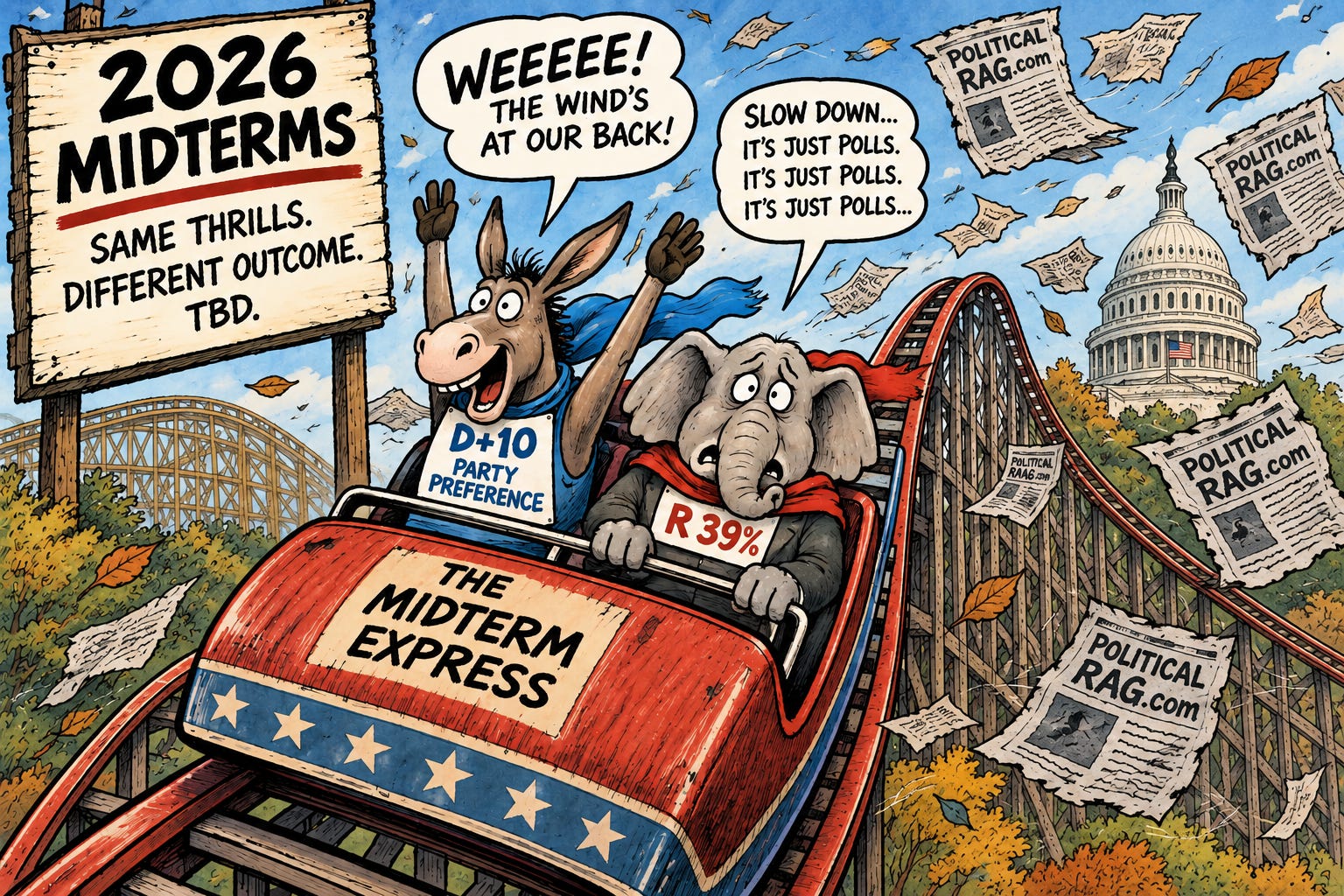
As of Q2, it’s a ten-point gap, with 49% identifying as Democrats or Democratic-leaners, and 39% as Republican or leaning Republican. That’s a substantial swing from two years ago when Gallup found that 46% were in the GOP camp versus 44% for the Democrats during the same period. At the same time, Democrats continue to hold a modest advantage in the generic congressional ballot.
This is a considerable Democratic advantage in the national partisan environment that history tells us can produce a wave election. Just as early voters are beginning to receive their ballots for November, it’s worth considering whether 2026 will be another wave year.
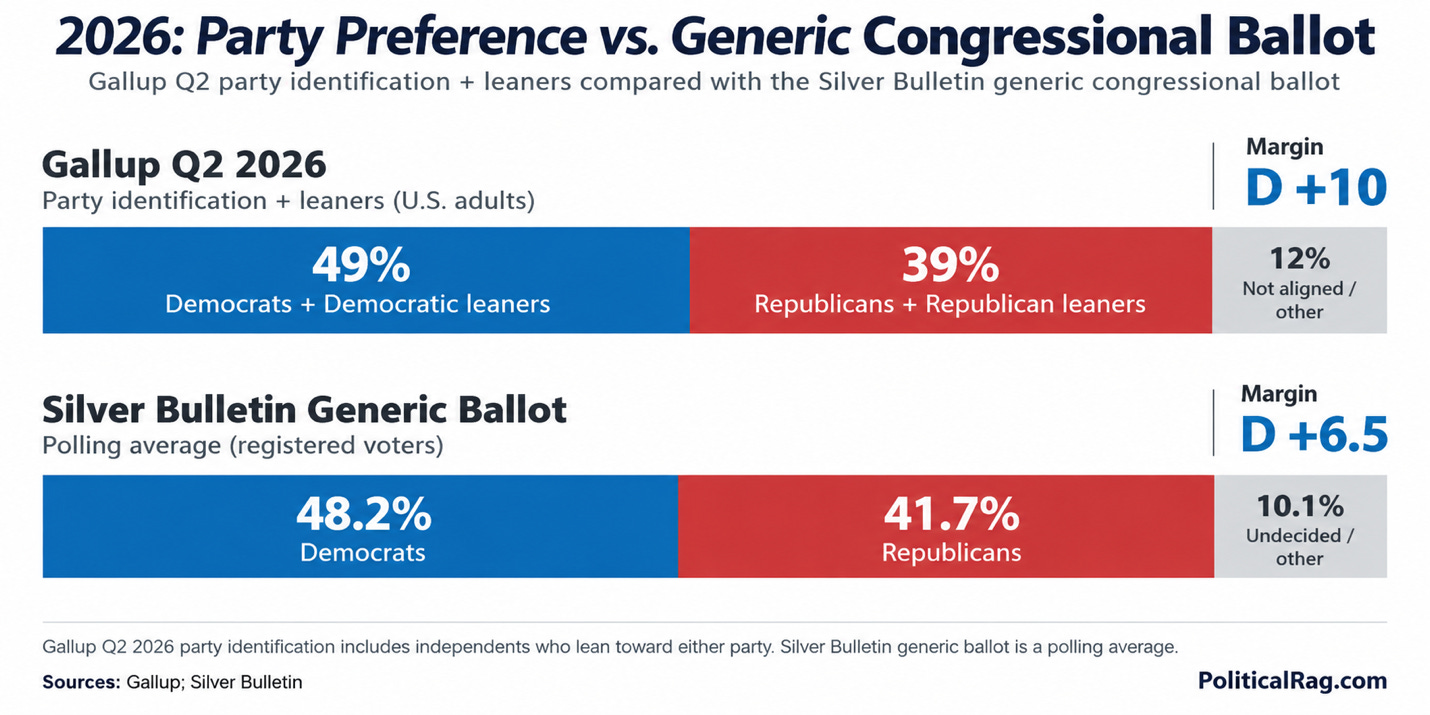
What a wave in 2026 looks like is not something we can determine yet, and waves always look like they were obvious after all the votes have been counted. Right now, a double-digit partisan environment is looking like a mid-single digit Democratic advantage in the House. But history tells us that even small shifts in the partisan environment can lead to major shifts in voters’ preferences.
Let’s define a wave in the House as a double-digit change gain/loss and a flip/expanding party control. In the wave years of 1994, 2006, 2008, 2010, and 2018 there was either a significant contraction of the gap between Democratic and Republican preference (typically favoring the former) that led to massive Republican gains in 1994 and 2010; or there was a widening of the gap that led to Democratic waves in 2006, 2008, and 2018. There are, of course, instances when the narrowing/widening of the partisan gap didn’t lead to a major change in the House, but the dynamics of the election matter, such as 1996 and 2012, which we can classify as status quo elections when the incumbent Democratic presidents won re-election, while his party picked up a few seats in the House, but not enough to win back the huge majority the Republicans won in the previous midterm election.
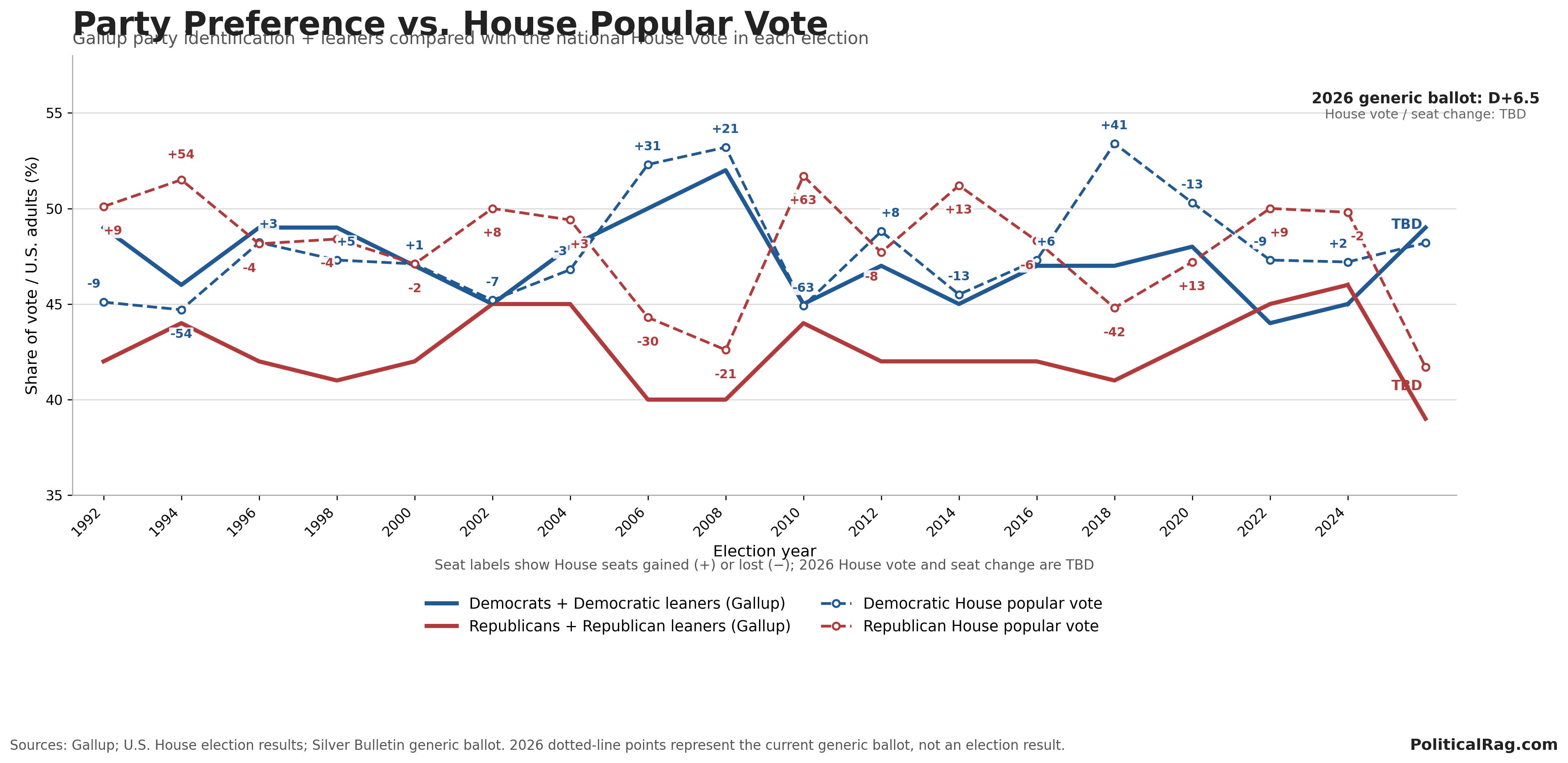
But it’s not enough to just say party preference is the determining factor and call it a day. The context here matters significantly. For each of those five wave years, the large swings in party preference came because of backlash to the party in power. That’s typical in wave elections since there are essentially two choices American voters get, and as much as party loyalists want to believe that everyone thinks like them, Pew Research has shown us that only 39% of voters are staunchly committed to either the Democrats or the GOP. That doesn’t mean 61% of the country are registered independents (Gallup finds independents represent about 44% of the country before they decide which way they lean), but it does mean that a sizable portion of the country is open to bucking the party they voted for last time (or even the last several).
Which brings us to 2026. The partisan gap doesn’t directly correlate to the number of seats a party could win. A larger partisan gap has historically been tied to larger electoral swings, but it’s not a one-to-one relationship. The current partisan balance is in the range that Democrats enjoyed in 2008 before Barack Obama’s landslide election, and higher than the 8-point advantage the party had before its 2006 wave election in George W. Bush’s final two years in the White House.
The major reasons driving this in 2026, of course, are economic concerns around rising costs. The problem is compounded by voter opposition to Trump’s policies on tariffs and the war with Iran, that voters see as a major culprit. The president, for his part, seems all too happy to put himself and his policies at the center of the election, giving his party little breathing room to separate themselves from him, where appropriate. Republicans’ clearest counterstrategy is to make the election a referendum on Democrats and their most progressive candidates (pour a cold glass of Haterade). Whether this strategy is successful remains to be seen. The president’s approval rating has been stuck below 40%, and 2026 is not 2024 or 2022, where backlash was against Democratic policies and Joe Biden, who is now retired.
Trump and Republicans are eager to paint all Democrats as socialists, given the rise of Democratic Socialist candidates in a handful of primaries, but this may not bear the fruit the incumbent party hopes it will. A summer survey from CNBC found that endorsements from the president made 52% of voters less likely to support a Republican candidate, and 57% of voters were less likely to support a candidate that described themselves as MAGA. Comparatively, 50% of voters were less likely to support a candidate that described themselves as Democratic Socialists.
For their part, Democrats cannot just be the opposition party (though it certainly helps). They also need to skate where the puck is going – to put it another way – speak to voters’ concerns. Democratic candidates have been very message disciplined talking about economic concerns and making the election a referendum on the president. They will also need effective responses to charges of socialism. Gallup finds that 81% of Americans still rate free enterprise positively, while just 39% feel the same about socialism. If the question becomes one of fairness, basic services, or the social safety net, 52% of independents, and even 19% of Republicans have positive views. How Democrats talk about these things will matter.
The national environment is plainly more favorable to Democrats than it was two years ago. The partisan balance has moved sharply, the generic ballot has moved with it, and history shows that environments of this magnitude can produce significant House swings. But the historical record also shows that national vote share is an imperfect predictor of seats.
The question for the next 56 days isn’t whether the environment has shifted. It has. The question is how effectively Democrats translate that environment into individual congressional races — and whether Republicans can change the terms of the election with a rapidly closing window of opportunity to do so. Because ballots are already beginning to circulate.
© 2026 Center Field Strategies LLC | Political Rag is an imprint of Center Field Strategies