



I earlier wrote about ideology dominating over electability in Republican primaries (see here: Ideology vs. Electability) and Senate Republicans just suffered another casualty from President Trump’s quest to make ideology (i.e., loyalty to him) the key requirement for his support. John Cornyn was a conservative’s conservative and had an 85% lifetime conservative rating from the American Conservative Union. But that wasn’t enough to spare him in the Texas Senate runoff versus the Trump-endorsed Ken Paxton.
Paxton, of course, is (in)famously scandal plagued. I won’t discuss that laundry list, but it begs the question – is there a limit to the power of Trump’s backing in a general election? Do Democrats stand a chance of claiming a seat from Texas for the first time in thirty-eight years with State Rep. James Talarico?
As Anakin Skywalker once said, “This is where the fun begins!”
Texas, of course, has long been a desired prize for Democrats to turn at the statewide level. But try as they have many times to claim its electoral votes, a senate seat, or the governor’s mansion, it has long eluded them. But 2026 is not 2024, 2020, or 2018.
As red as Texas is, Trump is not exactly popular there right now. Polls disagree about whether he has plurality favorability or unfavorability in the Lone Star State, but what they do agree on is that his rating is under 50%. In the generic congressional ballot, Texas has also swung left by nearly double digits relative to its presidential result in 2024. That year, Trump carried the states by 13.68 points, but polling now shows a Republican edge of 3.79 points. That margin has been tightening as well. In April it was a 5.3-point Republican lead and in May it was 4.84.
Does that edge mean it will be a close, but inevitable Paxton win?
The answer is a bit murky – naturally. Or at the Germans of Fredericksburg, Texas would say – natürlich.
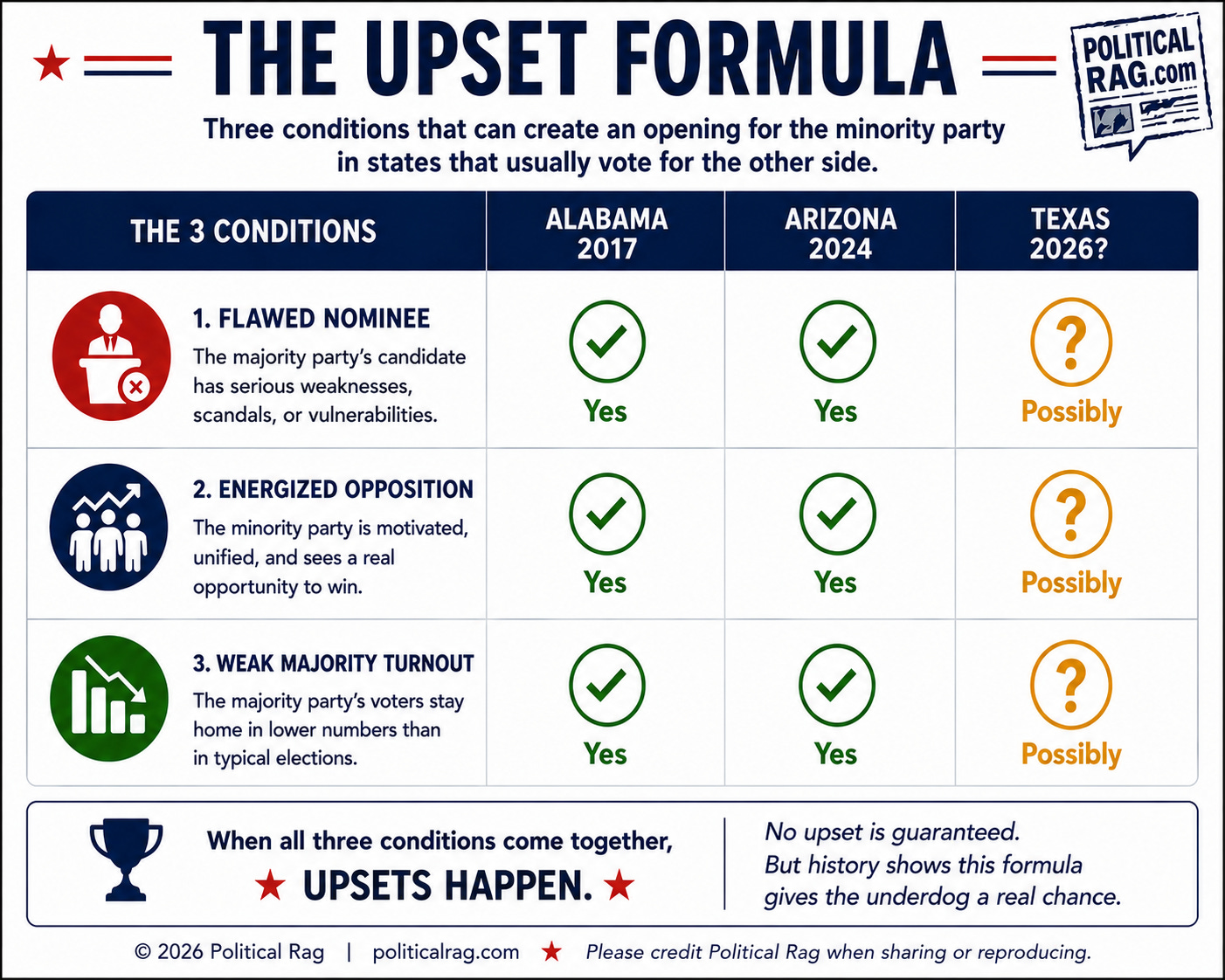
Anytime a state goes against what its numbers tell us, it always seems impossible until it happens. But every time it happens, it’s a unique combination of circumstances that push the state over the edge. Usually you have:
1. A flawed nominee
2. High opposition party enthusiasm
3. Underwhelming majority party turnout
So, let’s look no further than two recent examples of an otherwise Republican state that ended up electing a Democrat to the Senate – Alabama and Arizona.
In 2017, Alabama elected Democrat Doug Jones to an open Senate seat in a special election. His Republican opponent, Roy Moore, had a long list of scandals to his name as well, making him a deeply flawed nominee. Jones ended up winning by over a point-and-a-half in a state that the previous year had voted for Trump by over 27 points. He didn’t do so by suddenly making Republicans want to vote Democrat. Exit polling found that just 2% of Republicans voted for Jones. Instead, his victory came about because Democratic enthusiasm was through the roof with 37% of the electorate compared to 43% Republican. The remaining 21% were independents, who went for Jones by an 8-point margin. It was enough to give him a narrow win. But a win is a win.
So: Flawed nominee? Check. High opposition party enthusiasm? Check. Underwhelming majority party turnout? Check.
Now, I know naysayers will point out that this was a special election with 40% turnout. True, and midterm elections are lower turnout affairs to begin with. Texas’s other Senator, Ted Cruz, won re-election in 2018, when Democrats came within 2.5 points of knocking him off, with about a 42% turnout of the voting age population. No one is questioning the legitimacy of Cruz’s win. Others might point out that a few years later Jones was knocked off during a regular election schedule. Also, true. But it doesn’t change the fact that it happened in a state that by all measures should have been an easy Republican hold.
But okay, I’ll see your Alabama and raise you Arizona, which elected Democrat Ruben Gallego to the Senate in 2024 while it also gave Donald Trump its 11 electoral votes. Gallego’s Republican opponent, Kari Lake, while less scandal plagued than Paxton or Moore, was controversial nonetheless in both 2024 and in her 2022 run for governor (also a Republican year than saw Lake lose to Katie Hobbs, giving Democrats the Arizona governorship for the first time since 2006). Gallego won the race by just under 2.5 points while Trump won the state by more than 5.5 points. In this instance, Gallego’s success did come from getting just enough Republicans, 10% according to exit polling, to vote for him over Lake, and additionally eking out a 48%-47% edge with independents. Gallego outperformed Kamala Harris by over 93,000 votes, while Lake underperformed Trump by over 174,000 votes.
Gallego couldn’t even claim to be a moderate in the race. He consistently received high ratings on progressive scorecards as a member of the U.S. House and was vice chair of the Congressional Progressive Caucus, but he fit himself to the veteran-heavy profile of the state, emphasizing his own service in the Marine Corps and ability to lead. Lake, by contrast, consistently focused on her ties to Trump, which was not enough to carry her.
So: Flawed nominee? Check. High opposition party enthusiasm? Check. Underwhelming majority party turnout? Check, but of course with an asterisk since Gallego over performed Kamala Harris.
Naysayers here will point out this seat was already in Democratic hands with Kyrsten Sinema, that Arizona had already elected Mark Kelly to the Senate and Katie Hobbs as Governor, and that Arizona had swung to Joe Biden in 2020. All of that is true. But it doesn’t change the fact that Trump carried Arizona in 2024 by a healthy 5-point margin and it still wasn’t enough to pull a heavily flawed Lake along with him.
Which brings us back to Texas.
Flawed nominee?
It’s easy to point out Paxton’s many flaws. Talarico’s message to Texas voters last night was to remind them that Paxton has a criminal record. But some of this may already be baked in since Texans have twice elected Paxton as their attorney general. Though Cornyn did a good job of putting Paxton’s dirty laundry front and center, which is going to resonate beyond the GOP base.
High opposition party enthusiasm?
Democrats are over the moon at the thought of winning this seat now. Talarico has a massive cash advantage over Paxton, who has been a weak fundraiser, and we can expect that money to keep coming. Talarico’s campaign reported raising over $600,000 in the hours after Paxton’s primary win. Democrats are also turning out in huge numbers like just about everywhere else in the country. But Talarico also is culturally liberal in a conservative state. How he manages to thread that needle will be key for him.
Underwhelming majority party turnout?
Democrats nationally are riding a high wave of enthusiasm. Polling has found that the percentage of Democrats enthused to vote this year is in the high 60’s or low 70’s, compared to the mid-to-low 50’s for Republicans.
Where Paxton goes from here could make the difference. Does he make a pitch to bring Cornyn supporters into the fold or does he go the way of Kari Lake who told the John McCain wing of the party in Arizona to go to hell? What happens if Cornyn, now liberated, joins Senators Bill Cassidy of Louisiana and Thom Tillis of North Carolina in voting against Trump on certain issues? Does Paxton go scorched earth to remind Trump of his own loyalty while risking alienation of Cornyn supporters?
So: Flawed nominee? Certainly seems so. High opposition party enthusiasm? Building. Underwhelming majority party turnout? TBD.
This is still Texas, so structurally the advantage goes to Paxton. But given the right circumstances Talarico could pave a path to victory. The bottom line is that the Texas Senate race just got a lot more interesting.