


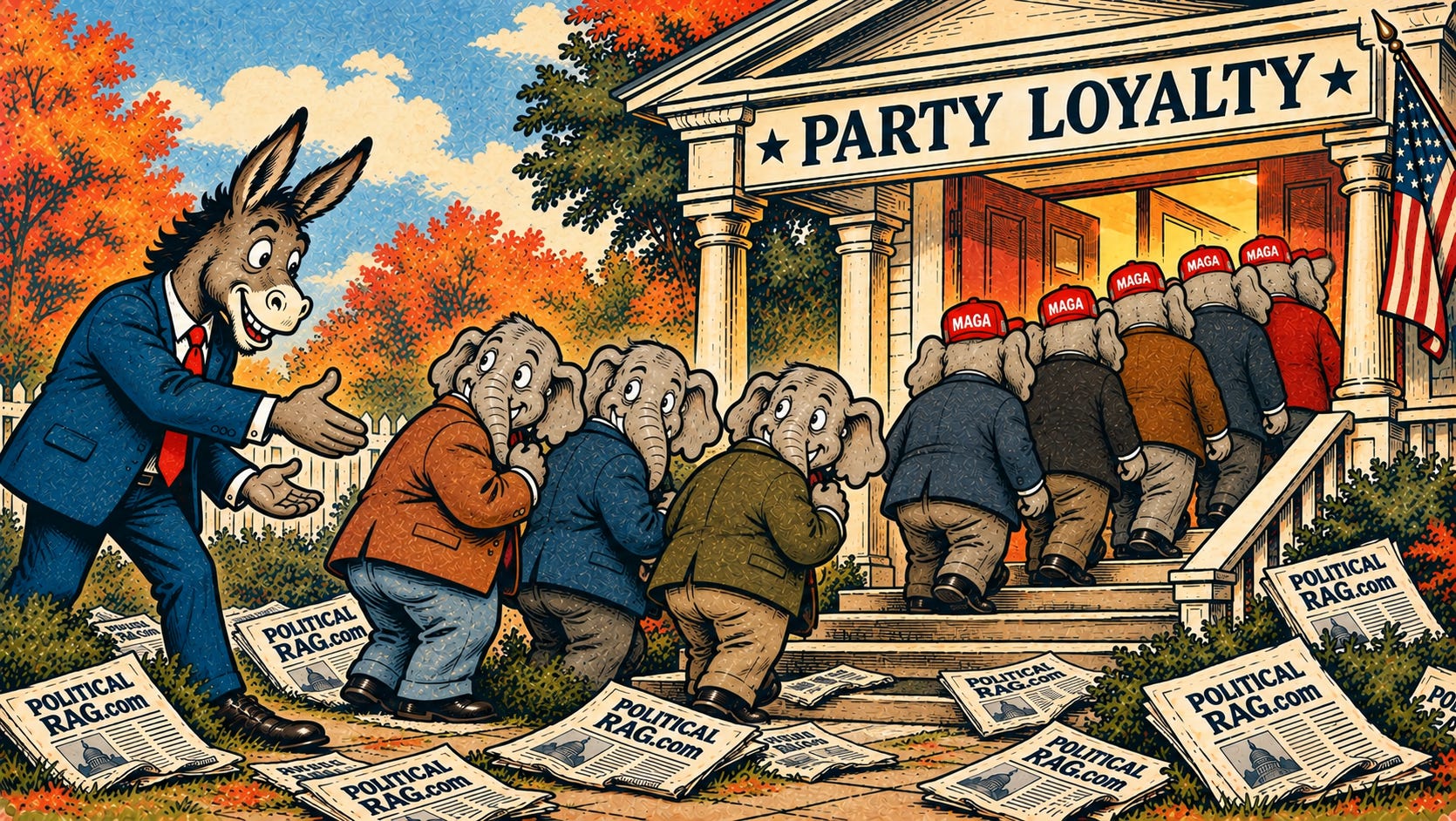
If you follow enough election-related news, you’ve probably heard the theory that party loyalists “come home” by Election Day. In other words, they may register their anger with their preferred party early on in an election cycle, but when push-comes-to-shove, they stay loyal to their party.
Largely, yes. In today’s hyperpartisan environment, voters are less likely to cross party lines. But two factors could complicate that conventional wisdom in 2026: whether each party’s voters are equally motivated to turn out, and whether some factions of Republicans are more willing to cross over.
The Senate races in Texas, Iowa, and Ohio, are good places to zoom in on the factors of 2026. These are states that Trump won in 2024 by an average 12.6-points, and he won in all three of his turns at the ballot box. But today, all three play host to competitive races. As with everything Political Rag does, following the data tells us why.
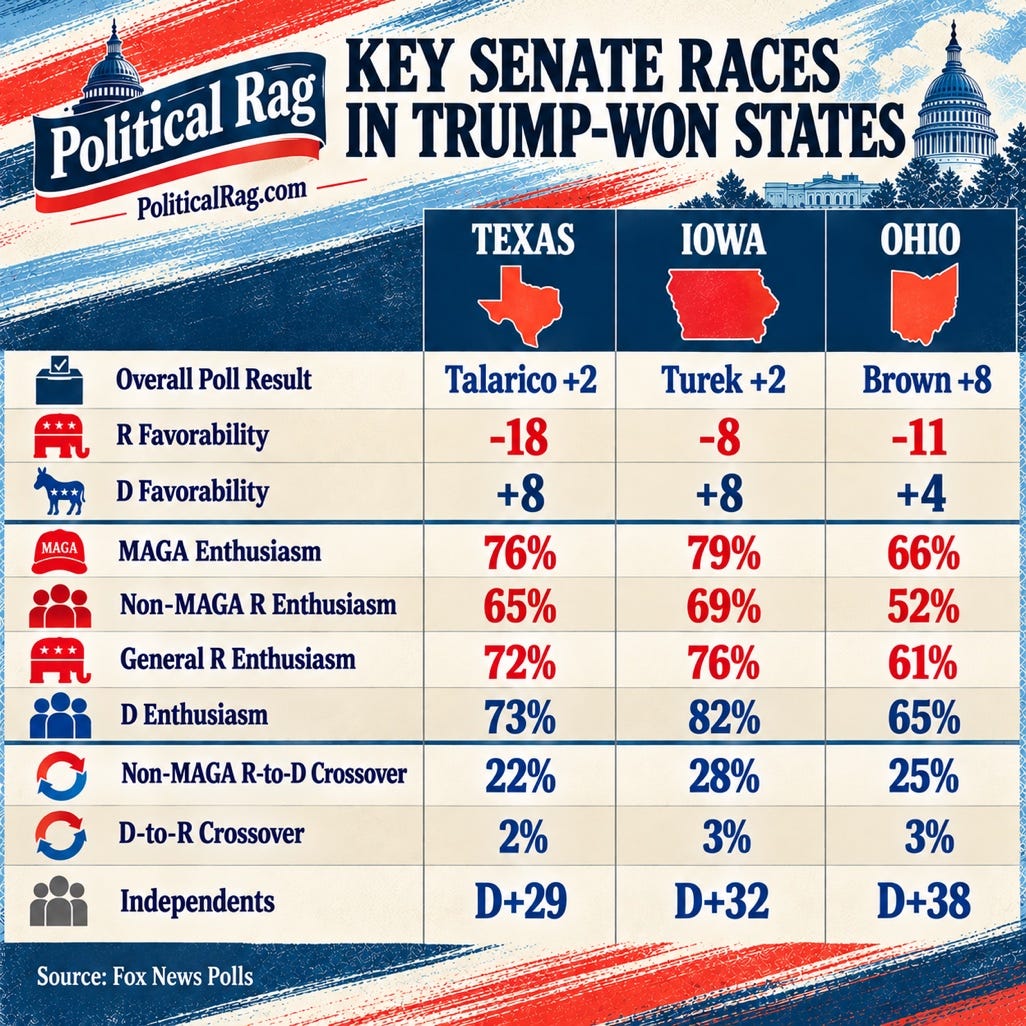
Polling from Fox News finds that in all three states, Democrats continue to exceed Republican enthusiasm to vote this year. But Fox News also distinguishes between MAGA and non-MAGA Republicans, which is where things get tricky for the GOP.
In all three states, MAGA enthusiasm is roughly on par with Democratic enthusiasm. But among the non-MAGA Republicans, enthusiasm drops an average 11-points below their MAGA counterparts. Compounding that problem for the GOP is that in every state, an average one-quarter of the non-MAGA Republicans indicate they’re planning to pull the lever for the Democratic candidate.
So, it begs the question, if the GOP is trying to juice Republican voter turnout, which Republicans are they trying to turn out? The strategy so far has been to send in President Trump or Vice President Vance to the competitive states, but what does that do for the non-MAGA Republicans? In Texas, for example, 53% of non-MAGA Republicans disapprove of the job the president is doing and 56% hold an unfavorable view of Republican nominee Ken Paxton. It’s a similar story in the other states, and it creates the possibility of a double-edged sword: causing non-MAGA Republicans, who already give low marks to the president, to stay home or further galvanize their support for the Democrat. Because at this point, just a few weeks out from Election Day, opinions are likely to be firmly set.
On the flip side, Democratic unity is all but universal, with crossover voting for the Republican senate candidate sitting at an average of less than three points – basically a rounding error. The Senate nominees – James Talarico, Josh Turek, and Sherrod Brown – all hold net-positive favorability ratings, versus their Republican opponents who are all well underwater. Combined with the high levels of voter enthusiasm, the party loyalist theory is holding up, so far, for Democrats in 2026.
It also is necessary to point out where independents sit in each of these races, which is a wide average of 33-points in favor of the Democratic nominee. It cannot be understated just how much of an advantage this is for Democrats. If Republicans were holding their own with independents, then none of these races would be in the conversation of the competitive senate map. In 2024, for example, President Trump won independents in Texas by 1-point and in Ohio by 2-points.
Some Republicans are questioning the accuracy of polling, saying (hoping?) that 2026 could be more like 2022, which saw a Republican trickle versus a wave against the then-Democratic majority. It’s a fair question to ask, but the environmental shift against Republicans is not theoretical. We’ve seen it happen already.
Look no further than Virginia’s 2025 gubernatorial election, when Democrat Abigail Spanberger won a 15-point landslide, all state officer positions flipped, and the Democratic majority expanded in the general assembly. This was not a special election (which some fairly argue is not the best indicator of future elections) and the 55% turnout matched the 2021 election when Republican Glenn Youngkin won the governor’s mansion, and the down-ballot results were the opposite of 2025.
Exit polling from CNN found Spanberger won 14% of non-MAGA Republicans. 9% of Republicans overall crossed over to vote for Spanberger, while just 1% of Democrats voted Republican; and Spanberger won independents by a wide 20-point margin.
Turnout in 2025 mattered significantly. Rural counties that normally support Republicans in the Old Dominion shifted by an average 12 points towards Democrats, helped by a 14-point drop in Republican turnout versus 2021 when Republican Glenn Youngkin won. In the major metropolitan areas of Virginia, Republican turnout dropped by an even larger 20 points. Democrats meanwhile experienced a 19-point and 17-point surge in turnout in each respective area compared to 2021.
None of this is theoretical. It happened. And it happened at a moment when the president still had a 42% approval rating, versus 37% today. An unpopular war with Iran had not sparked off. The national average price of a gallon of gasoline was $3.05 and diesel was $3.75, versus $4.33 and $6.31, respectively.
What happens in November is anybody’s guess. But if we’re following the data and what this sour environment for Republicans has already produced, then we can at least know that the remaining days left in the election will feature highly competitive races up-and-down the ballot. Not just in swing states or districts, but more consequentially, in traditionally Republican strongholds.
© 2026 Center Field Strategies LLC | Political Rag is an imprint of Center Field Strategies